Why Glue-Down LVT Dominates Commercial Flooring Specifications
Walk into a modern retail store, corporate office, or healthcare facility, and you will often find glue-down LVT used in high-traffic areas. By bonding directly to a properly prepared subfloor, glue-down LVT provides a stable, durable surface that performs well under rolling loads, heavy foot traffic, and demanding commercial conditions.
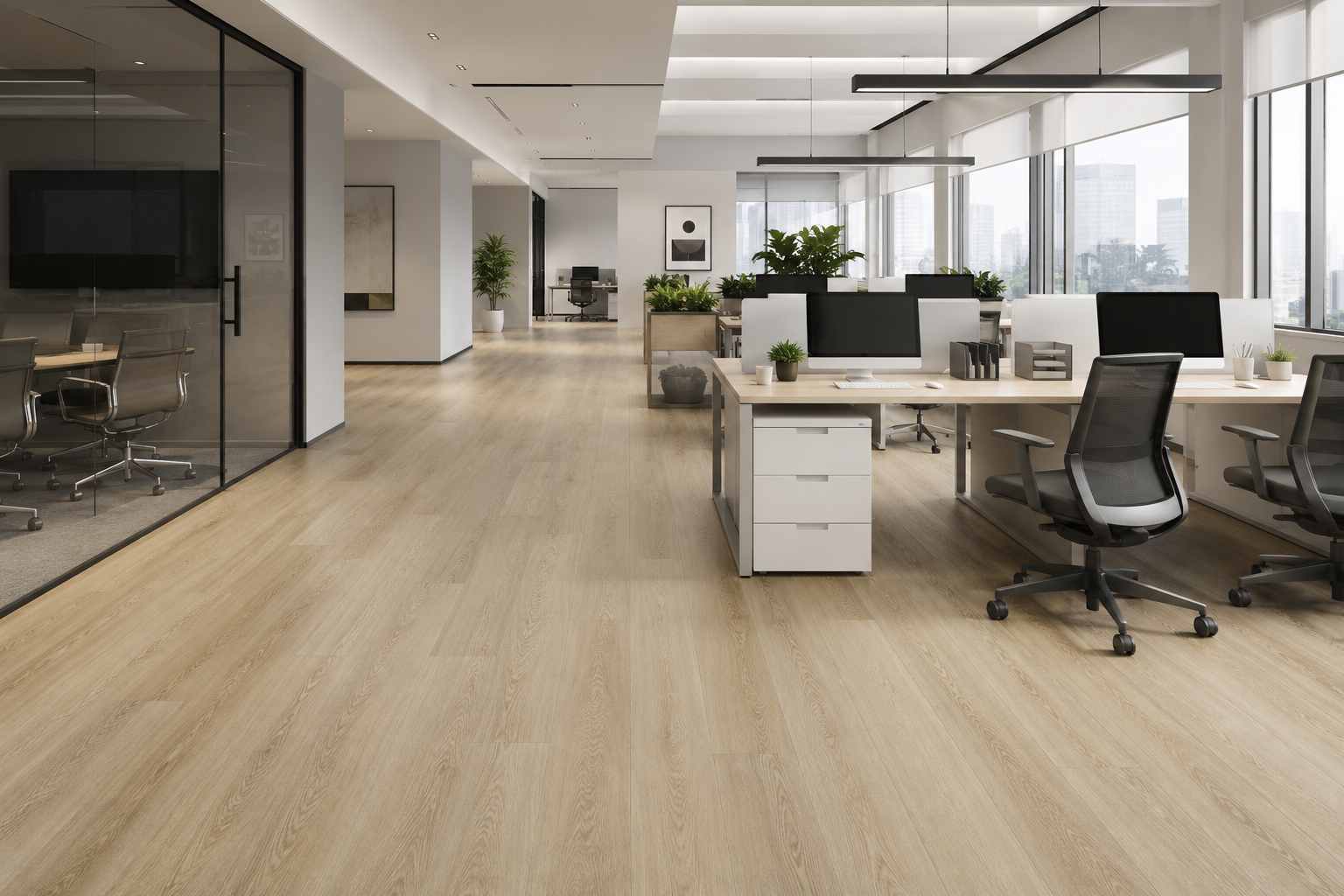
The key difference is the installation method. Unlike floating click-lock systems, glue-down LVT is bonded directly to the prepared subfloor with flooring adhesive, providing a stable and secure installation. This helps minimize plank movement and can reduce the hollow sound sometimes associated with floating floors, making glue-down LVT well suited for demanding commercial environments.
For facility managers, contractors, and specifiers, glue-down LVT offers a durable flooring solution for high-traffic applications. UltraSurface provides commercial LVT options designed for demanding environments, with different wear layers, designs, and specifications to meet project requirements.
Understanding Commercial-Grade Wear Layers: 20mil vs 22mil vs 28mil
The wear layer is the transparent protective layer above the design film. Measured in mils (1 mil = 0.001 inch), it helps determine how well commercial LVT resists scratches, scuffs, and surface wear.
For commercial projects, choosing the right wear layer is important. 20 mil, 22 mil, and 28 mil options provide different levels of durability for different traffic conditions and application requirements.
| Wear Layer | Metric Equivalent | Commercial Rating | Ideal Applications |
|---|
| 12 mil | 0.30 mm | Light Commercial | Private offices, hotel guestrooms, small boutiques |
| 20 mil | 0.50 mm | Medium Commercial | Retail corridors, open-plan offices, classrooms, reception areas |
| 22 mil | 0.55 mm | Heavy Commercial | Healthcare corridors, airports, supermarkets, restaurants |
| 28 mil | 0.70 mm | Extreme Traffic | Transit hubs, department stores, industrial showrooms |
Note: Wear layer is only one factor in commercial LVT performance. Total thickness, construction, surface treatment, adhesive, subfloor preparation, and traffic conditions should also be considered when selecting the appropriate specification.
For commercial spaces such as offices, retail stores, and restaurants, 20 mil, 22 mil, and 28 mil wear layers can be selected based on traffic levels and project requirements. Higher wear layers provide greater protection against everyday scratches, scuffs, and surface wear.
A polyurethane or aluminum-oxide surface treatment can provide additional protection for the wear layer. UltraSurface commercial LVT is available with 0.30 mm to 0.70 mm wear layers and UV-cured polyurethane surface coatings, offering options for different commercial applications.
The Anatomy of Commercial LVT: What is Beneath the Surface
Commercial LVT typically uses a multi-layer construction, with each layer contributing to durability, appearance, dimensional stability, or installation performance.
- Polyurethane Surface Treatment: Provides additional protection against scratches, scuffs, stains, and everyday cleaning.
- Wear Layer: A transparent protective layer, typically available in different thicknesses, that helps resist surface wear under commercial traffic.
- Decorative Print Film: High-resolution printed film creates realistic wood, stone, concrete, and other visual designs.
- Core Layer: The main PVC-based layer provides flexibility, strength, and dimensional stability. Some products may include fiberglass reinforcement.
- Backing Layer: Provides structural balance and supports reliable bonding during glue-down installation.
- Key Takeaway: Commercial LVT performance depends on the complete flooring construction—not just the wear layer. Surface treatment, core formulation, backing, total thickness, and installation conditions should all be considered when specifying a product.
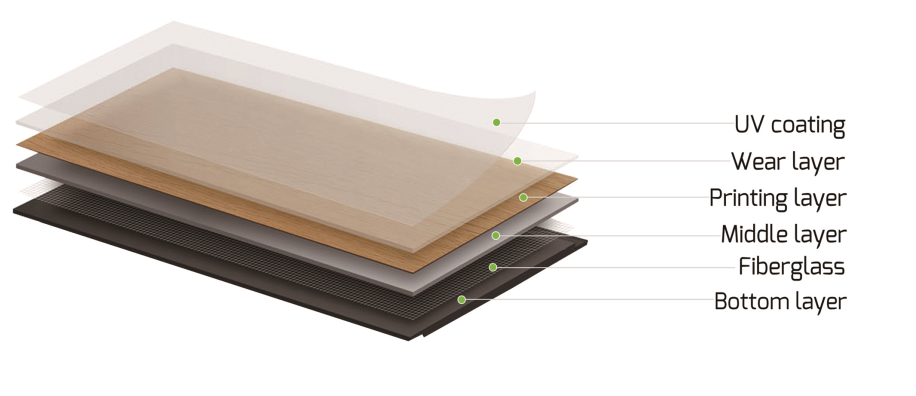
This layered construction allows commercial LVT to combine the visual appeal of natural wood and stone with the durability and practical benefits of modern vinyl flooring. UltraSurface commercial LVT features fiberglass-reinforced construction designed to enhance dimensional stability across temperatures from 10°C to 40°C, supporting reliable performance in commercial environments with varying climate conditions.
Adhesive Selection: Hard-Set vs Pressure-Sensitive for Commercial Projects
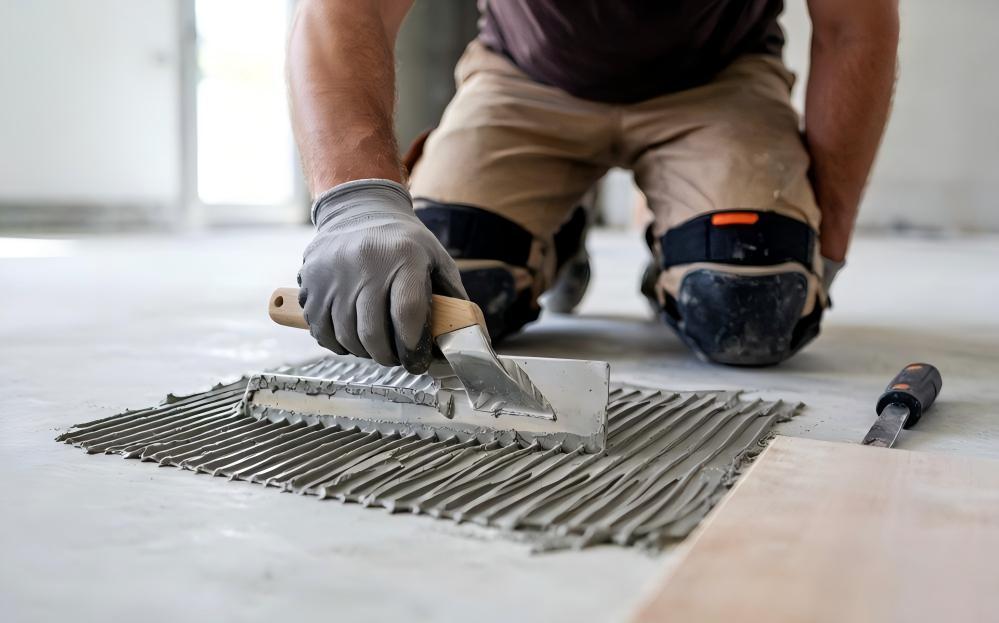
The adhesive is a critical part of any commercial glue-down LVT installation. The right adhesive must be matched to the flooring, subfloor, traffic conditions, and project requirements to ensure reliable long-term performance. Two common adhesive types are widely used for commercial glue-down LVT installations, each with different performance characteristics and application requirements.
Hard-Set (Wet-Lay) Adhesives
Hard-set acrylic adhesives form a firm bond between the LVT and subfloor, making them suitable for commercial areas exposed to heavy traffic and rolling loads. The flooring is installed while the adhesive is still wet, following the adhesive manufacturer's recommended open time and installation procedure.
Pressure-Sensitive Adhesives (PSA)
Pressure-sensitive adhesives provide a flexible bonding system with easier positioning and potential for simpler plank replacement. They are commonly used in commercial applications where installation flexibility and future maintenance are important. Adhesive selection should always consider the flooring specification, traffic level, subfloor conditions, and the manufacturer's installation requirements.
| Property | Hard-Set Adhesive | Pressure-Sensitive Adhesive |
|---|
| Bond Type | Firm, permanent bond | Pressure-sensitive, repositionable |
| Installation | Install while adhesive is wet,
per manufacturer instructions | Allow adhesive to flash off before installation |
| Rolling Load Resistance | Excellent | Good (lower shear resistance) |
| Tile Replacement | Difficult | Easy (heat and lift) |
| Best For | Healthcare, airports, retail | Offices, retail fit-outs, hospitality |
| Key Advantage | Strong bond for
demanding traffic | Easier installation and future maintenance |
Note: Open time, moisture/RH limits, and application requirements vary by adhesive product. Always follow the adhesive manufacturer's technical data sheet and installation instructions. For commercial LVT, adhesive selection should be based on the flooring specification, traffic conditions, subfloor moisture, and project requirements—not adhesive type alone.
Always match the adhesive to the specific LVT product, subfloor conditions, and moisture level. Test concrete moisture according to applicable standards, such as ASTM F1869 or ASTM F2170, and follow the flooring and adhesive manufacturer's allowable moisture limits. If moisture levels exceed the specified limits, appropriate moisture mitigation or a moisture-tolerant adhesive may be required.
Subfloor Preparation: ASTM F710, F2170, and F1869 Standards
For commercial glue-down LVT, proper subfloor preparation is essential for installation performance and warranty compliance. Concrete flatness, surface condition, and moisture levels should be verified before installation according to applicable ASTM standards and the flooring and adhesive manufacturer's requirements.
Concrete Slab Requirements (ASTM F710)
Concrete substrates should be properly cured, clean, dry, and structurally sound. Many commercial LVT installations require the subfloor to be flat within approximately 3/16 inch over 10 feet (4.8 mm over 3 m). Cracks, damaged areas, and uneven surfaces should be properly repaired before installation.
Moisture Testing: ASTM F2170 and F1869
Concrete moisture should be tested before installing glue-down LVT. Two commonly used methods are:
-
ASTM F2170 — In-Situ Relative Humidity: Measures the internal relative humidity of the concrete slab using probes installed at specified depths.
-
ASTM F1869 — Calcium Chloride MVER: Measures moisture vapor emission from the concrete surface.
Allowable moisture levels vary by flooring and adhesive system. If test results exceed the manufacturer's limits, a suitable moisture mitigation system or moisture-tolerant adhesive may be required before installation.
Key Takeaway: Proper moisture testing and subfloor preparation are essential for reliable glue-down LVT performance. Always follow the applicable ASTM standards and the specific installation requirements provided by the flooring and adhesive manufacturers.
Step-by-Step Commercial LVT Glue-Down Installation Process
A professional commercial glue-down LVT installation requires proper acclimation, subfloor preparation, adhesive application, and rolling. The following steps provide a practical reference; always follow the flooring and adhesive manufacturer's installation instructions for project-specific requirements.
Step 1: Acclimate the LVT
Store unopened LVT cartons in the installation area at approximately 18–29°C (65–85°F) for at least 48 hours, unless otherwise specified by the manufacturer. Maintain stable temperature and humidity conditions before, during, and after installation to help minimize dimensional movement.
Step 2: Prepare the Subfloor and Plan the Layout
The subfloor must be clean, dry, smooth, and structurally sound. For many commercial LVT installations, maintain flatness within approximately 3/16 inch over 10 feet (4.8 mm over 3 m). Remove dust, grease, adhesive residue, and other contaminants before installation.
Establish layout lines before applying adhesive and plan the starting point carefully. Stagger plank end joints according to the flooring manufacturer's recommendations, typically avoiding repeated joint alignment between adjacent rows.
Step 3: Apply the Adhesive
Use an adhesive approved for the specific LVT product and substrate. Apply it with the trowel type and notch size specified by the adhesive manufacturer. For some smooth-back LVT systems, a 1/16" × 1/16" × 1/16" square-notch trowel may be recommended.
Work in manageable sections and observe the adhesive's required open time or flash-off time. Pressure-sensitive adhesives may require the adhesive to become tacky before installation, while wet-lay systems are installed while the adhesive remains wet.
Step 4: Install and Roll the Flooring
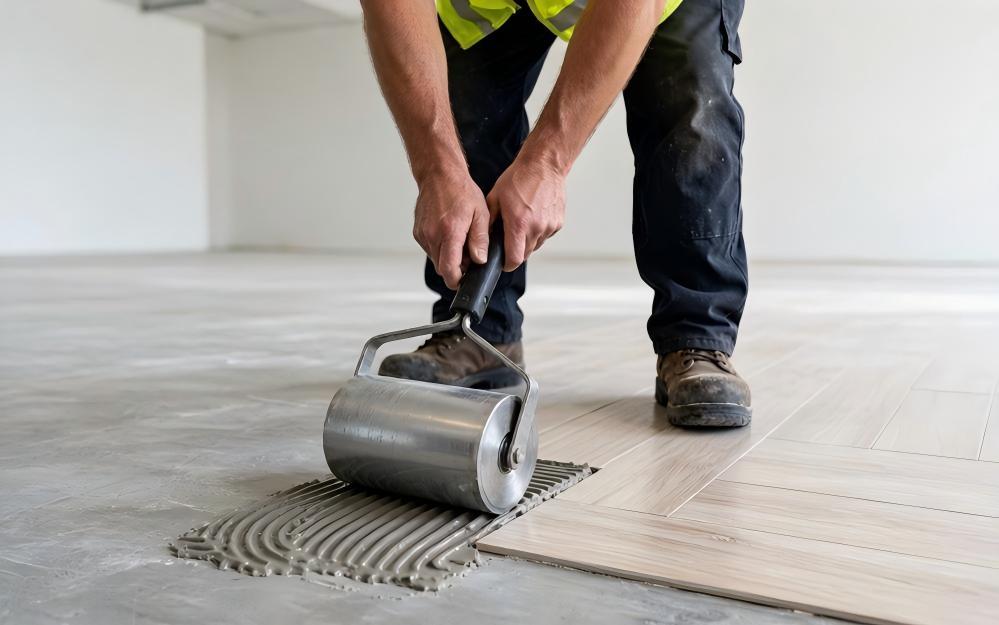
Place each plank firmly into the adhesive, maintaining proper alignment, tight seams, and the required joint pattern. After installation, use the roller specified by the flooring or adhesive manufacturer. A 100-lb (45 kg) roller is commonly used for some commercial glue-down LVT systems, with rolling typically performed in both directions to promote consistent adhesive transfer and minimize air pockets.
Step 5: Allow the Floor to Cure and Protect the Surface
Keep foot traffic off the newly installed floor for approximately 24 hours, or for the period specified by the adhesive manufacturer. Heavy furniture, rolling loads, and construction traffic should be restricted until the adhesive has sufficiently cured.
For ongoing construction, protect the completed floor with suitable breathable protection materials. Avoid direct application of high-tack tape to the finished surface, as it may damage the wear layer or leave adhesive residue.
Key Takeaway
Proper installation is just as important as the quality of the LVT itself. Following the recommended temperature, subfloor flatness, adhesive application, rolling, and curing requirements helps commercial LVT achieve reliable long-term performance.
Rolling Load and Heavy Traffic Performance: Why Glue-Down LVT Excels
The key advantage of glue-down LVT in demanding commercial environments is its direct bond to the subfloor. Unlike floating click systems, which rely on mechanical locking between planks, glue-down LVT is secured across the entire plank surface with flooring adhesive.
This direct bond helps minimize lateral movement and provides stable support under rolling loads such as office chairs, hospital beds, wheelchairs, and retail carts. For this reason, glue-down LVT is widely specified for healthcare, retail, hospitality, offices, and other high-traffic commercial spaces.
Why Glue-Down LVT Performs Well Under Rolling Loads
-
Direct subfloor bonding: Adhesive secures the flooring across its entire backing area.
-
Reduced plank movement: A properly bonded installation helps minimize shifting and joint movement.
-
Stable under rolling traffic: Suitable for areas exposed to office chairs, carts, wheelchairs, and other wheeled equipment.
-
Flexible specification options: Wear layers such as 20, 22, and 28 mil can be selected according to traffic levels and project requirements.
For commercial projects, wear layer, total thickness, adhesive system, subfloor preparation, and installation quality all contribute to long-term performance. Where rolling traffic is a major concern, selecting the appropriate glue-down LVT system can help improve installation stability and lifecycle performance.
Key Takeaway
Glue-down LVT is particularly well suited to commercial environments where rolling loads and heavy foot traffic are frequent. Its direct adhesive bond provides a stable installation and makes it a strong option for healthcare, retail, hospitality, and other demanding applications.
Commercial Space Applications: Retail, Office, Healthcare, and Hospitality
Different commercial environments have different flooring requirements. Glue-down LVT can be specified with different wear layers, constructions, and adhesive systems to match traffic levels, maintenance requirements, and design expectations.
Retail Stores

Retail floors must handle frequent foot traffic, shopping carts, display fixtures, and regular maintenance while maintaining an attractive appearance. 20, 22, and 28 mil wear layers can be selected according to traffic and project requirements. Pressure-sensitive adhesives may also be considered where future plank replacement and maintenance flexibility are important.
Corporate Offices
Open-plan offices experience frequent rolling traffic from office chairs and mobile equipment. Commercial LVT with 20–28 mil wear layers provides options for different traffic levels, while glue-down installation helps maintain a stable surface under rolling loads. For multi-story buildings, acoustic performance should be evaluated based on the complete flooring assembly and applicable project requirements.
Healthcare Facilities
Healthcare environments require flooring that can withstand frequent foot traffic, rolling beds, carts, and regular cleaning. LVT with 22–28 mil wear layers can provide enhanced surface protection for demanding areas, while appropriate surface treatments can improve resistance to stains and routine cleaning chemicals. Installation details should also be selected according to the facility's hygiene, maintenance, and performance requirements.
Hospitality and Restaurants
Hotels, restaurants, and other hospitality spaces need flooring that combines visual appeal, durability, and ease of maintenance. Glue-down LVT offers a wide range of wood, stone, and concrete visuals, with wear layer options from 20 to 28 mil for different traffic conditions. In areas exposed to frequent spills, select products and installation systems designed for the required moisture and slip-resistance conditions.
UltraSurface offers commercial LVT with wear layers from 0.30 mm to 0.70 mm (12–28 mil), along with a wide range of wood, stone, and concrete designs. Different thicknesses, constructions, and surface treatments can be specified to meet the requirements of retail, office, healthcare, hospitality, and other commercial projects.
Common Commercial Installation Failures and How to Prevent Them
Even high-quality commercial LVT can experience installation problems when moisture, subfloor conditions, adhesive application, or curing requirements are overlooked. The following are common installation issues and practical ways to prevent them.
1. Skipping Moisture Testing
Excessive moisture in concrete can affect adhesive performance and long-term flooring stability. Test concrete according to applicable standards such as ASTM F2170 and ASTM F1869, and compare the results with the moisture limits specified by the flooring and adhesive manufacturers.
2. Inadequate Subfloor Flatness
Uneven concrete can telegraph through LVT and affect adhesive contact. For many commercial installations, a flatness tolerance of approximately 3/16 inch over 10 feet (4.8 mm over 3 m) is commonly specified. Repair low spots, high spots, cracks, and other surface defects before installation.
3. Incorrect or Worn Trowel
The adhesive manufacturer's specified trowel notch is important for achieving proper adhesive coverage. A worn trowel can reduce adhesive transfer and create weak bonding areas. Check the trowel regularly and replace it when the notch profile becomes worn.
4. Ignoring Adhesive Open Time
Installing LVT too early or too late can affect adhesive performance. Follow the manufacturer's specified open time, flash-off time, and working time, particularly when using pressure-sensitive or wet-lay adhesives.
5. Insufficient Rolling
Proper rolling helps improve adhesive transfer and minimize air pockets beneath the flooring. Some commercial LVT systems specify a 100-lb (45 kg) roller, with rolling performed in both directions after installation. Always follow the flooring and adhesive manufacturer's rolling requirements.
6. Allowing Traffic Too Early
Premature foot traffic or rolling loads can disturb the adhesive bond before it has sufficiently cured. A 24-hour waiting period for normal foot traffic is common for some systems, while heavy rolling loads may require longer. Follow the adhesive manufacturer's curing requirements.
7. Improper Acclimation
Installing LVT before it reaches the recommended installation conditions can contribute to dimensional movement after installation. As a general reference, some products require approximately 48 hours of acclimation at 18–29°C (65–85°F). Always check the specific flooring manufacturer's requirements.
Key Takeaway
Most commercial LVT installation problems can be prevented before the first plank is installed. Proper moisture testing, subfloor preparation, adhesive selection, installation technique, and curing are essential for achieving reliable long-term performance.
Maintenance and Warranty: Protecting Your Commercial Floor Investment
Commercial LVT is designed for easy maintenance, but regular care is still important. Proper cleaning, floor protection, and timely maintenance help preserve the wear layer and support long-term flooring performance.
Daily Maintenance
-
Regular dust mopping: Remove dirt and abrasive particles that can contribute to surface wear, especially in high-traffic areas.
-
Damp mopping: Use a pH-neutral cleaner recommended for the flooring. Avoid abrasive cleaners, harsh chemicals, and solvent-based products that may damage the surface treatment.
-
Walk-off mats: Place suitable entrance mats at building entrances to help reduce the amount of dirt and moisture carried onto the floor.
-
Furniture protection: Use appropriate protective pads or casters under furniture and rolling equipment to minimize indentation and surface damage.
Understanding Commercial Warranties
Commercial LVT warranties vary by product, wear layer, application, and manufacturer. Before specifying a product, review the warranty requirements for:
- Wear and performance coverage: Warranty periods vary according to the product specification and intended application.
-
Installation requirements: Proper subfloor preparation, moisture testing, adhesive selection, acclimation, and installation procedures may be required for warranty coverage.
-
Maintenance requirements: Improper cleaning, excessive moisture, chemical damage, and failure to follow recommended maintenance procedures may be excluded.
-
Application rating: Select LVT according to the intended traffic level and commercial application. A product designed for residential use should not automatically be assumed to be suitable for demanding commercial environments.
Always review the specific product warranty before installation and keep installation and maintenance records for commercial projects.
Why UltraSurfaceFloor Is Your Commercial LVT Partner
For commercial glue-down LVT projects, product construction and technical support are both important. UltraSurface offers commercial LVT solutions for contractors, distributors, and project specifiers, with wear layer options from 0.30 mm to 0.70 mm (12–28 mil).
Available specifications can include UV-cured surface treatments, fiberglass-reinforced construction, and high-definition wood, stone, and concrete designs, depending on the product series.
UltraSurface can also support commercial projects with product samples, technical data sheets, installation guidance, adhesive compatibility information, and project-specific specifications.
Whether the project is a small retail space or a large commercial development, selecting the appropriate LVT construction and following proper installation and maintenance procedures can help achieve reliable long-term performance.
Contact UltraSurface for commercial LVT samples, technical specifications, and B2B project support.